
Route5: GOLDRUSH
In 1849, the world emptied itself into a single city. Three hundred thousand people abandoned everything and rushed to San Francisco - A town of barely a thousand the year before - because there was gold in the ground, and for a brief window it belonged to whoever got there first.
That rush built California. But the part the postcards leave out is that it never ended. San Francisco just changed what it digs for. Gold became silicon. Silicon became the hardware that powered the most influential companies of the last 40 years.
But the rules of who gets to reap the rewards have changed.
For a century, the IPO was a chance for the common man to get a piece of the pie: a company listed, and the public was invited in to grow alongside it. Amazon went public in 1997 worth $438 million and handed the public the next twenty years. That was the deal.
That dream is gone because companies no longer need it. Private capital markets liquidity got so deep that the best companies raise billions for ten or fifteen years without ever ringing the bell. So they don't. And that has flipped what an IPO is: once the starting line, now the exit.
The hatch early birds climb out of after the growth, not the door the public climbs in through to come along for the ride.
Look at Snowflake. Worth $5 million at its Series A in 2012, $12.4 billion by its final private round in early 2020 and IPO'd at $33B. That entire climb happened in private hands.
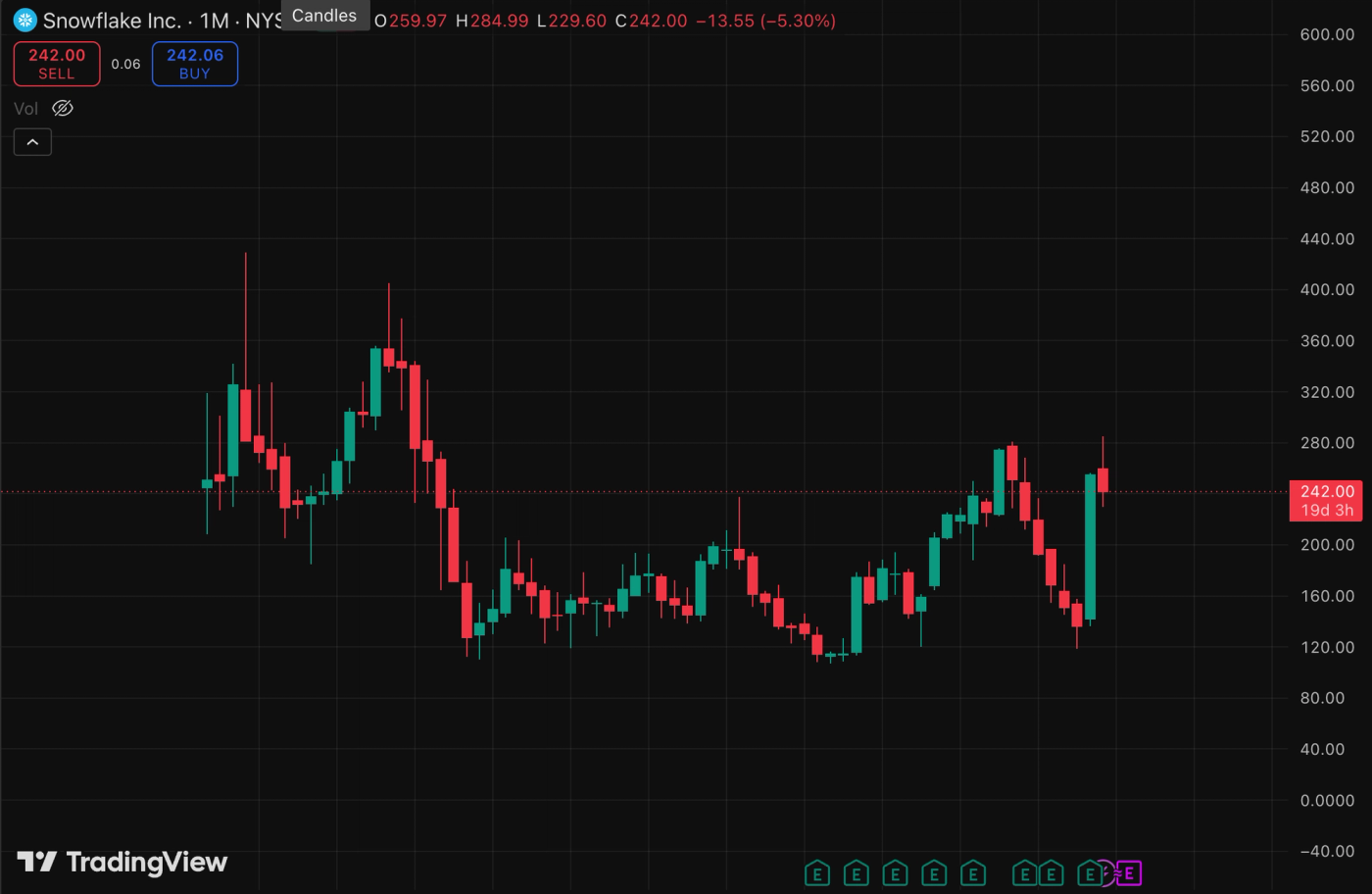
If you bought at IPO, you'd be down nearly 50% until about a month ago. And unfortunately, this is not the only case
That's the first shift: the value moved to the private side of the market. Here's the second — it's now moving there faster than ever.
AI has dropped the cost of building a company to near zero. What used to take a team, a year, and millions of dollars now takes a fraction of each. Companies form faster, ship faster, raise faster, and get repriced faster than at any point in history.
And this will only get faster.
Every month, more value is created, and almost all of it accrues privately. To put the scale plainly, the entire seven-year 1849 rush produced around $2.7 billion of gold in today's money, and Anthropic raised 24x more than that in a single afternoon.
The richest seam of wealth creation in history, in the same city it always has been — and the way ordinary people used to walk through to join it has been made redundant.
A door stays open only while the people inside need something from the people outside. For a century, that's what kept the public market honest — companies needed the public's capital, so they let the public in. Take the need away, and there's nothing business to be done.
Anthropic, OpenAI, SpaceX — they've raised billions privately, for as long as they like. They don't need your money. And a company that needs nothing from you owes nothing to you — including a way in.
Now, we've all seen the workarounds, but now any unauthorized secondary platforms, SPV/tokenized share/equity related exposure is coming under scrutiny
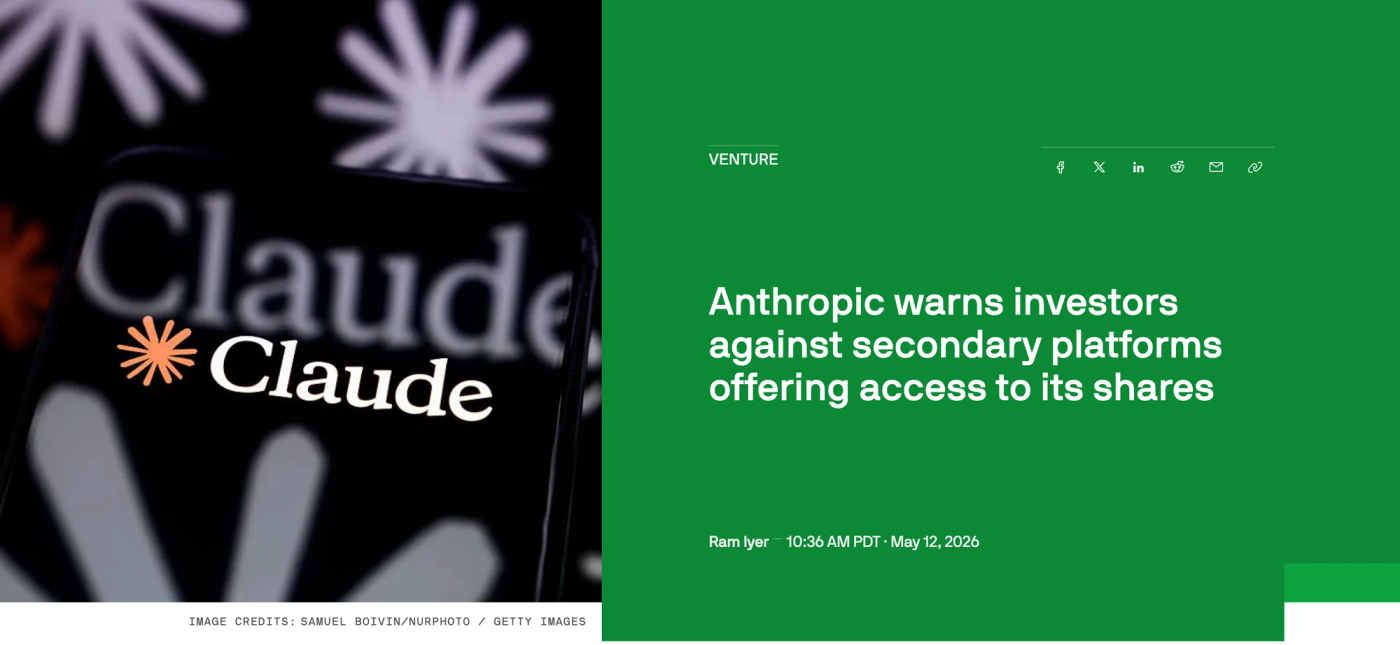
In May 2026, Anthropic declared every sale of its stock via secondary market platform void. Not discouraged — void, as in it never happened. Buy exposure through an SPV, a tokenized share — anything it hadn't blessed — and the company's position is that you hold nothing.
Then it named and shamed eight platforms in public, for the crime of giving people a way in. OpenAI did the same within a day.
This was never one week's news, though. It's a transfer twenty-five years in the making. The US had 8,090 public companies in 1996; today, around 4800 - the market nearly halved while the economy doubled. Private capital grew 25-fold over the same stretch, and a dollar invested there in 2000 became nearly $20 by 2025, against $6.60 in public markets.
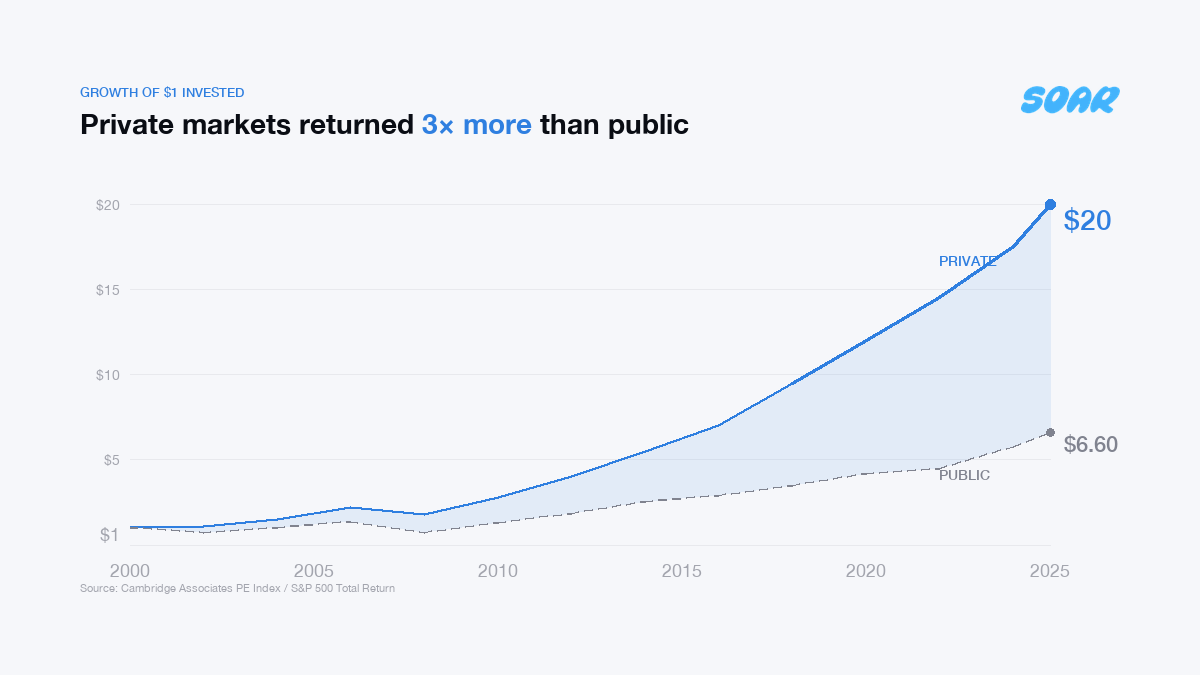
The best companies, the steepest growth, the highest returns, all of it migrated to the private side of a wall that pretty much all American households are legally barred from crossing.
The thing is demand as large as this cannot be quenched so easily.
One thing: someone builds a way over the wall.
It is the most reliable pattern in the history of finance. A market fills with value, a wall goes up around it, and the demand left outside doesn't pack up and go home — it presses, until someone builds the way through, like a water piercing through a shabbily built dam.
Commercial real estate was a rich man's asset, gated behind capital most people would never have — until the REIT, and a warehouse two states away became something anyone could own a piece of from a brokerage account. Owning the broad market meant getting a portfolio manager and fees to match, until the index fund turned the entire market into a single, cheap thing to hold.
Buying a share of a public company used to mean a broker, a significant minimum deposit, a steep commission on every trade, until that, too, was stripped to a tap on a phone.
commitments, the asset class creating the most wealth, growing the fastest, and sealed the tightest - it is the one that never got its workaround.
That's why we are building that at Route5.
Every workaround before failed the same way: It touched the shares. Secondary brokers are..well… just that, an SPV is a box holding the company's stock. A tokenized share is a wrapper around the company's stock. As long as the thing inside is the company's stock, the company has a hand on the kill switch. That's the hand Anthropic used.
Route5 doesn't touch the shares. There's nothing to transfer, nothing to wrap, nothing for a board to veto.
Instead, Route5 creates synthetic assets built on execution risks. You take a position on what you think a company is worth and where it's heading, and you trade that position against everyone else doing the same, using execution risks under the hood to make it happen.
Markets resolve around real-word and verifiable outcomes, tying markets directly to the companies that they represent.
The fortunes that were built in 1849 were never created from those who dug for gold. Sam Brannan sold the shovels. Levi Strauss never panned a river, and everyone is still wearing his name. They didn't go and dig. They gave people the tools to find their gold.
At Route5, we are giving you the opportunity to gain exposure to the shovel of your choice. The chance to Give leadership visibility.
A liquid market on the fastest-growing companies on earth. No shares to transfer. No board to approve. No permission to ask for.
Every generation gets a window of opportunity to invest in generational assets. Each window came with a line drawn through it — and on one side stood the people who went after it, and on the other, the people who watched it happen and explained, afterward, why they couldn't.
The generational asset class of commitments is being opened up. The only question left is, which side of it are you on?